
An enterprise AI team told us their search system worked. It found the documents people asked for. What they wanted next was an understanding of the company around those documents: who was working on what, how decisions connected and which information described the situation today.
You can see the problem in a handover. The project plan names the original owner. A meeting moves the deadline. A later message makes launch conditional on a review. Finding all three documents still leaves a person to reconstruct what should happen next.
Aethos does that organizing work in the background. It turns source material into small, connected facts, uses those facts to maintain records of the business, and lets people and agents inspect the records and their evidence. Here is how that works, from an incoming document to an agent preparing its next action.
01Bring in the work
Start with the places decisions already happen.
Aethos collects configured workplace conversations, meeting notes, documents and business-system records. Connectors pick up changes; people can also upload files. Each source retains its identity and access scope.
Supported files become readable text. Office documents can also contribute embedded charts and images through transcription. The original source stays available behind the extracted knowledge.
02Extract the facts
A document contains more than one thing worth remembering.
Aethos identifies the people and projects in a document, then extracts facts and relationships as small claims called atoms. Each claim keeps its source, access scope, context and available dates. Long documents retain their section headings during processing.
Independent extraction reads are compared and checked against accepted fact and relationship types. This makes a claim something the system can inspect and correct individually.
03Connect the right people and work
Which Nora does the meeting mean?
A transcript says “Nora”; a project plan says “Nora Patel.” Another team works with a different Nora. Aethos compares candidate identities using names, aliases, contact details and the surrounding document. Similarity finds candidates; context decides the match.
An uncertain match can stay unresolved. A later pass revisits possible duplicates with more evidence, so an early guess does not have to become a permanent identity.
04Inside one node
Open a person. See the work around them.
A node is the maintained record of a person, project or other part of the business. This illustrative sales-manager record connects responsibilities and commitments to meeting notes, conversations and email.
On the right, that context becomes work: improve a recurring forecast, document an escalation, or draft a status update checked against CRM totals and the manager’s notes.
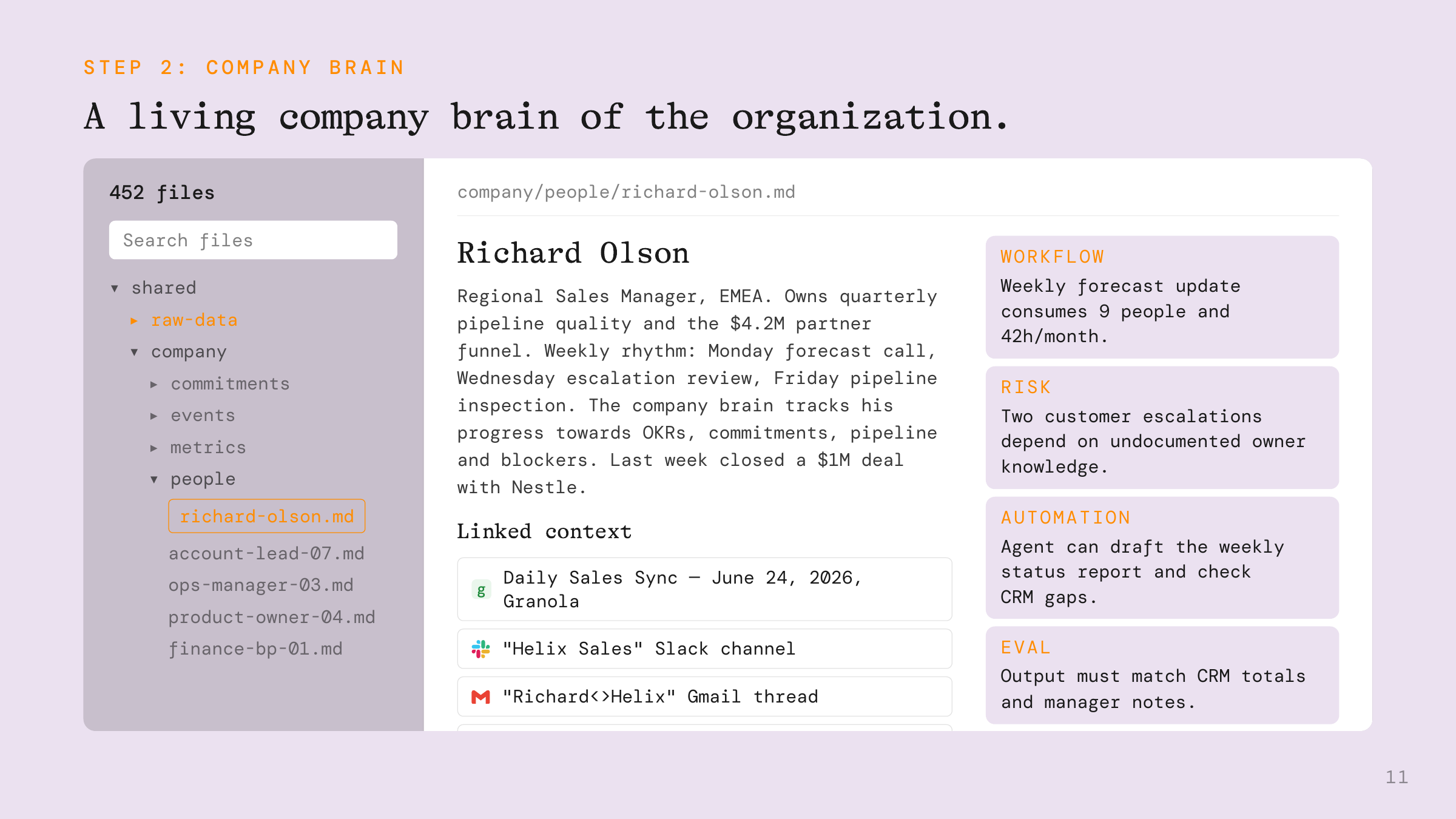
Illustrative node view from our enterprise AI transformation page. Names and figures are illustrative, not verified customer results.
05Maintain the current picture
Keep the history. Explain what changed.
Each record separates current facts, history and relationships. Repeated statements are consolidated. An old plan imported today retains its original date; it should not displace a newer decision.
“The date was wrong” corrects a claim. “The launch moved” records a real change. Aethos weighs dates, source authority and evidence; unresolved conflicts stay visible. Follow the invented supplier-portal rollout below, then apply its approval update.
From scattered records
to a useful next action.
Follow the same rollout from top to bottom.
Collect
A project plan, a handover note and an approval message enter through the connected sources.
Project plan[01]“Launch the supplier portal on Friday.”
Handover note[02]“Nora owns the rollout.”
Review message[03]“Security sign-off is still pending.”
Extract
Aethos separates the Friday plan, Nora’s responsibility and the security-review condition into individual claims.
Individual facts + their sources
- Planned date
- Friday [01]
- Rollout owner
- Nora [02]
- Security review
- Pending [03]
Connect
The meeting’s “Nora” is compared with existing people using the document and company context.
PersonNora PatelResolved from “Nora” [02]ownsProjectSupplier portalrequiresApprovalSecurity reviewMaintain
The rollout record brings the owner, planned date and latest review status together. Earlier states remain in its history.
Current recordBefore approvalSupplier portal
- Owner
- Nora Patel
- Planned launch
- Friday
- Security review
- Pending [03]
The plan is recorded. Launch is not yet confirmed.
Try it: a new message changes the record and the next action.
Original example: security review is pending.Retrieve
An agent opens the rollout record, follows the owner relationship and reads the approval source.
The agent asks“What should happen next?”
Answer with evidenceNora needs security sign-off before Friday’s planned launch.
Owner [02]Plan [01]Review [03]Act
The agent prepares a request for the current owner, using the latest plan and review status.
Next actionDraftTo: Nora PatelCould you arrange security sign-off before Friday’s planned launch?
One invented rollout, followed from source records to a draft action. Apply the approval update to see the current picture change while Friday remains a planned launch date.
06Give agents usable context
One maintained memory. More than one way to read it.
A known project name can lead straight to its record. A loosely described problem uses semantic search to find related entities. People and agents can then follow relationships or open the original sources to check an answer.
MCP makes those reads available to connected AI assistants outside Aethos. The assistant gets company context through Aethos and acts through its own tools and permissions.
07Carry corrections forward
Keep the correction for the next pass.
When an operator separates two people who were merged incorrectly, Aethos records the reason and feeds it into later extraction and identity checks. The correction can inform future matches.
The optional Learnings module handles broader guidance: people review a proposed lesson, choose its audience and make the approved wording available to agents through the Vault and MCP.
One mistaken identity
Nora
Owns the supplier rollout
Approves finance requests
Two people’s facts, combinedconfirms a split
Two separate records
Nora Patel
Owns the supplier rollout
Nora Kim
Approves finance requests
Remember why they are different. Use that distinction when matching “Nora” in later documents.
Confirmed identity corrections feed later matching checks. The people shown are invented.
08Context in a management review
Turn a disputed status into a useful question.
In one client build, Codos connected company goals to engineering activity, finance records and the people responsible. The executive view showed what an owner had reported beside what the supporting records indicated.
The work exposed a basic comparison problem: some targets and actuals used different units. The team put baseline, actual and target into the same measure before interpreting a gap. Missing evidence stayed visible, and disagreements became questions the owner could answer.
That is a concrete job for Company Brain in a weekly review: help a leader find the claim, inspect its basis and ask the right person for the missing answer. The owner’s clarification and the leadership decision still have to follow.
- See the claim
- Keep the owner’s reported status separate from the assessment based on connected records. A disagreement is something to examine.
- Open the evidence
- Follow the goal to its source, date and measure. Check that the actual and target describe the same thing.
- Ask the owner
- Turn the specific gap into an answerable question. Preserve an unknown state until the relevant evidence or clarification arrives.
09Fit the company
Build the context around work worth changing.
Start with a task that needs reliable context: a leadership briefing, customer handover or operational review. Test whether the agent finds the right person, explains the latest decision and shows its evidence.
Source ownership travels with extracted facts, and reads are scoped to the caller. Where personalized knowledge is enabled, readers can see different views of the same subject. Shared and private sources need deliberate configuration.
Aethos can run on your infrastructure. We agree the sources, model services, data flows and operational telemetry for the deployment, then expand against real tasks.
A few practical questions
Before we start.
What is the difference between Aethos and a company brain?
The company brain is the maintained knowledge of your business. Aethos is the Codos software that collects sources, extracts and connects facts, maintains the records and makes that context available to people and agents.
Does this replace our search system or business tools?
It can work alongside them. Aethos organizes context across connected sources and gives agents ways to retrieve it. The scope depends on what your existing systems already do well and where your workflows need more context.
Does every update instantly become approved company knowledge?
Updates move through collection, extraction and maintenance stages. Automated processing and human approval serve different purposes. Reviewed Learnings have an explicit acceptance process; a newly ingested document does not automatically become an approved instruction.
How do you judge whether it works?
Use real questions with known answers, including changed plans, ambiguous people and conflicting sources. Inspect the answer and its evidence, then test the downstream task. A useful brain should reduce the reconstruction and correction your team has to do.