
Engineering uses coding agents. Sales copies meeting notes into the CRM. Operations still assembles reports by hand. The Codos AI Readiness Diagnostic assesses those functions separately and recommends where to start.
Choose the teams, answer from today’s work and receive an opportunity range, recommended automations and a delivery plan. A sample report is available before you begin.
01What you get
Read the opportunity through the business.
The public sample models a retailer with 180 locations. It estimates $273K–$488K of annual opportunity realizable within 12 months and 265 hours a week of capacity across marketing and support.
Marketing contributes $137K–$244K; support contributes $136K–$243K. The marketing capacity alone illustrates the same team serving roughly 210 locations. These are model estimates, not customer results.
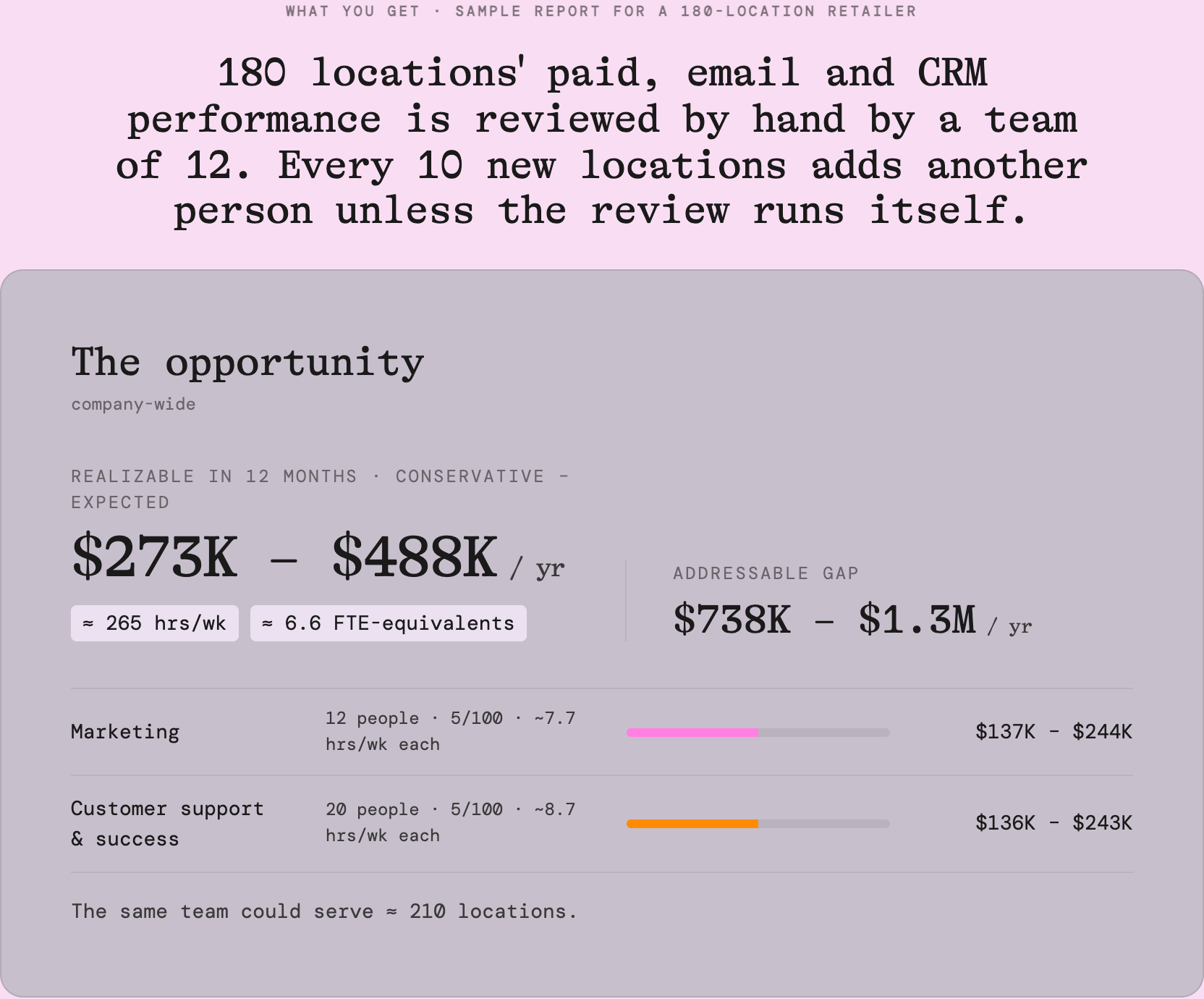
Actual screen from codos.ai/quiz. This is the quiz’s illustrative retailer sample, not a customer result. The figures are model estimates; the report labels the larger addressable gap separately from the amount estimated realizable within 12 months.
02Start with your company
Choose the teams. Keep the useful differences.
Assess a company, business unit or one department. The diagnostic starts with company and data questions, then adds your selected functions. Expect 15+ questions and about 5–8 minutes, depending on scope.
Choose engineering, sales, support, operations and back office, marketing, or product and design. Mark already AI-native functions to exclude them from the estimate. Headcount, industry, revenue and ownership give the report its business context.
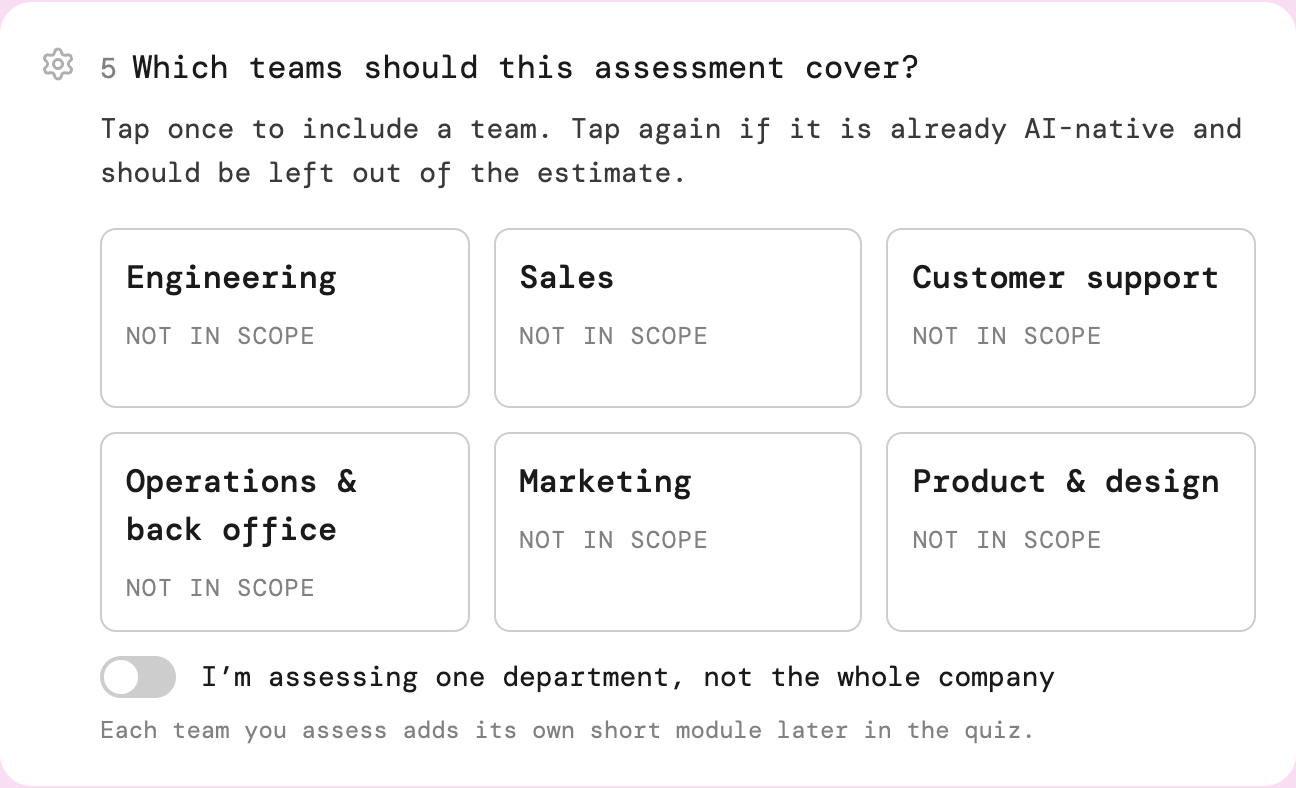
Actual questionnaire screen. Select the functions in scope, or mark a function as already AI-native. The report follows the scope you choose.
03What readiness measures
Can the company act on the opportunity?
The report checks four conditions for acting on the opportunity, using the change-management approach in our playbook:
- Role Models
- Who owns AI, and has any initiative produced an effect finance has verified?
- Skills Development
- What tools can people use, and do those tools have the company context needed to do useful work?
- Understanding & Conviction
- Does leadership have an explicit AI goal, and does the company know where people’s time goes?
- Formal Mechanisms
- Can AI act in the relevant systems, and are approved tools and data-handling rules clear?
04From answers to action
Leave with a named workflow to build.
The report recommends up to three plays, at most one per function, prioritized by modeled opportunity. Each includes interview questions: for meeting-to-CRM automation, what happens after a call, how long the update takes and what failed in earlier attempts.
- Automate meeting → CRM
- For a sales team still transferring conversations into records by hand: connect meeting capture, structured notes and the CRM update. Establish the fields, exceptions and owner before building.
- L1 triage agent
- For support teams doing repeated first-line classification: route requests with the context needed to handle them, and define when a person takes over.
- AI as first reviewer
- For engineering teams where review is a bottleneck: use AI to examine changes before the human review, then measure the work it removes and the quality of its findings.
- Content pipeline
- For marketing teams using AI for isolated drafts: connect research, brief, draft, review, publishing and measurement into a workflow the team can operate.
Other named plays include Reporting agent, Document intake and Feedback → backlog. The recommendation depends on your answers; every company does not receive the same list.
05Reading the numbers
Two ranges answer two different questions.
The addressable gap values work AI could help change. The realizable range narrows it using readiness, system access and a revenue-based ceiling.
Hours and FTE-equivalents represent capacity. Finance tests how that becomes growth, avoided hiring or lower expense. Unknown answers reduce confidence; functions missing the headcount or scored answers needed to price them are omitted from the dollar estimate.
Only the functions selected for assessment enter the opportunity calculation. Already AI-native functions are excluded.
Headcount, industry labor cost, the addressable share of work and function answers establish the size of the potential gap.
Readiness and system access narrow the estimate, with ranges reflecting uncertainty and a revenue-based ceiling limiting the total.
Validate the workload, build the workflow and agree with finance how released capacity becomes a measurable operating or financial result.
A reading guide to the quiz model. Select a step to see what contributes to the result.
06Inside a deeper diagnostic
Replace the estimate with work you can inspect.
The quiz gives an initial estimate from your answers. A deeper diagnostic checks it against the work itself: interviews with employees, a leadership discussion, and records from the systems they use.
In one back-office engagement, dozens of AI-led interviews mapped hundreds of operations in about two weeks. The useful finding was work crossing department boundaries: document drafting and report assembly appeared in several teams, creating shared queues worth investigating.
- A map of the work
- For each operation: the task, tools, reported time and variations. Employees’ descriptions preserve the knowledge that a process document often misses.
- Ranked workflow queues
- Group related work across functions. Compare cost, volume, variability, readiness and risk to decide which workflow deserves a closer look.
- Open validation questions
- Separate complete answers from missing hours or unclear assumptions. “Already automated” still needs a tool, a description of the manual steps left, and the time they take.
- A first-build decision
- Agree the workflow boundary, the evidence needed for a baseline and the systems it must reach. The opportunity estimate becomes a scoped implementation decision.
Interview-based hours are potential capacity, pending validation. In this diagnostic, correcting the treatment of partly automated work increased the recorded workload; it did not create a productivity gain.
07What comes next
The report opens a delivery plan.
The quiz report includes a 30-day checklist and 90-day plan. These are planning recommendations. A full engagement can begin with a month-long diagnostic; its scope and first production milestone are agreed separately.
Once a workflow is selected, engineers validate the workload with function leads, connect the necessary context and build it for its first users. Later stages extend it across the team, verify the effect with finance and select the next play.
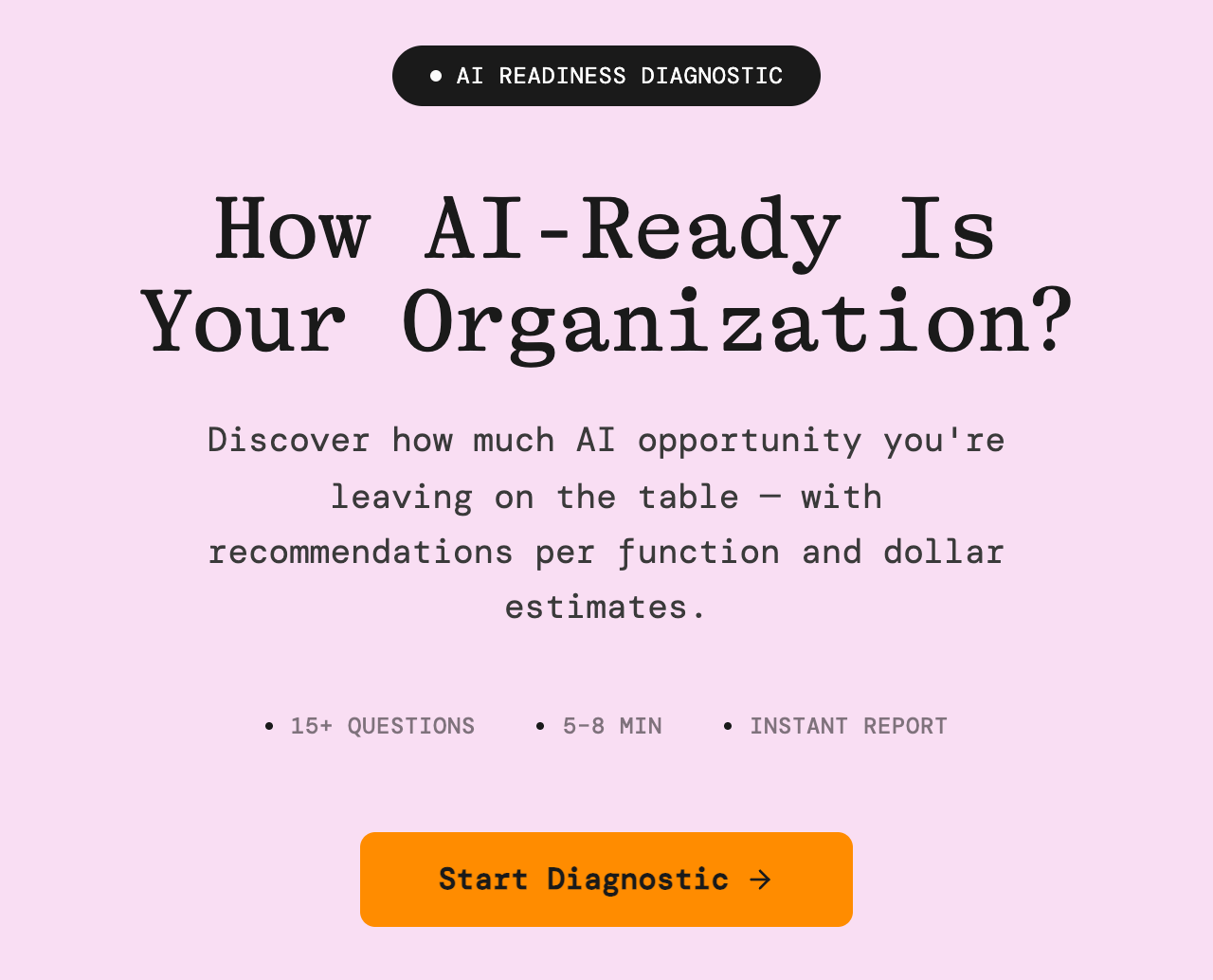
Start at codos.ai/quiz. The sample report is visible before you begin the diagnostic.
A few practical questions
Before we start.
How long does the AI readiness assessment take?
The self-serve diagnostic is designed for 5–8 minutes and starts with 15+ questions. The function modules you select determine the full scope. To view your personalized results, the final step asks for your name, email and role. The sample report is public and needs no details.
Can I assess just one department?
Yes. Select the one-department option and the relevant function. Use the headcount for the scope you are assessing. You can also mark other functions as already AI-native to exclude them from the opportunity estimate.
Are the dollar estimates guaranteed savings?
They are modeled opportunity ranges based on your answers, labor-cost assumptions, readiness and access to systems. A Codos diagnostic checks the underlying work and establishes a baseline; finance verifies the effect after implementation.
What do I get beyond a score?
A breakdown by function, an opportunity range, up to three recommended automation plays, interview questions, a 30-day deliverables checklist and a 90-day plan. These help you choose the first workflow and scope the next conversation.