
AI transformation companies in 2026: a map of 82 players and how to choose
I sell AI transformation for a living, so I am one of the 82 logos on this map.
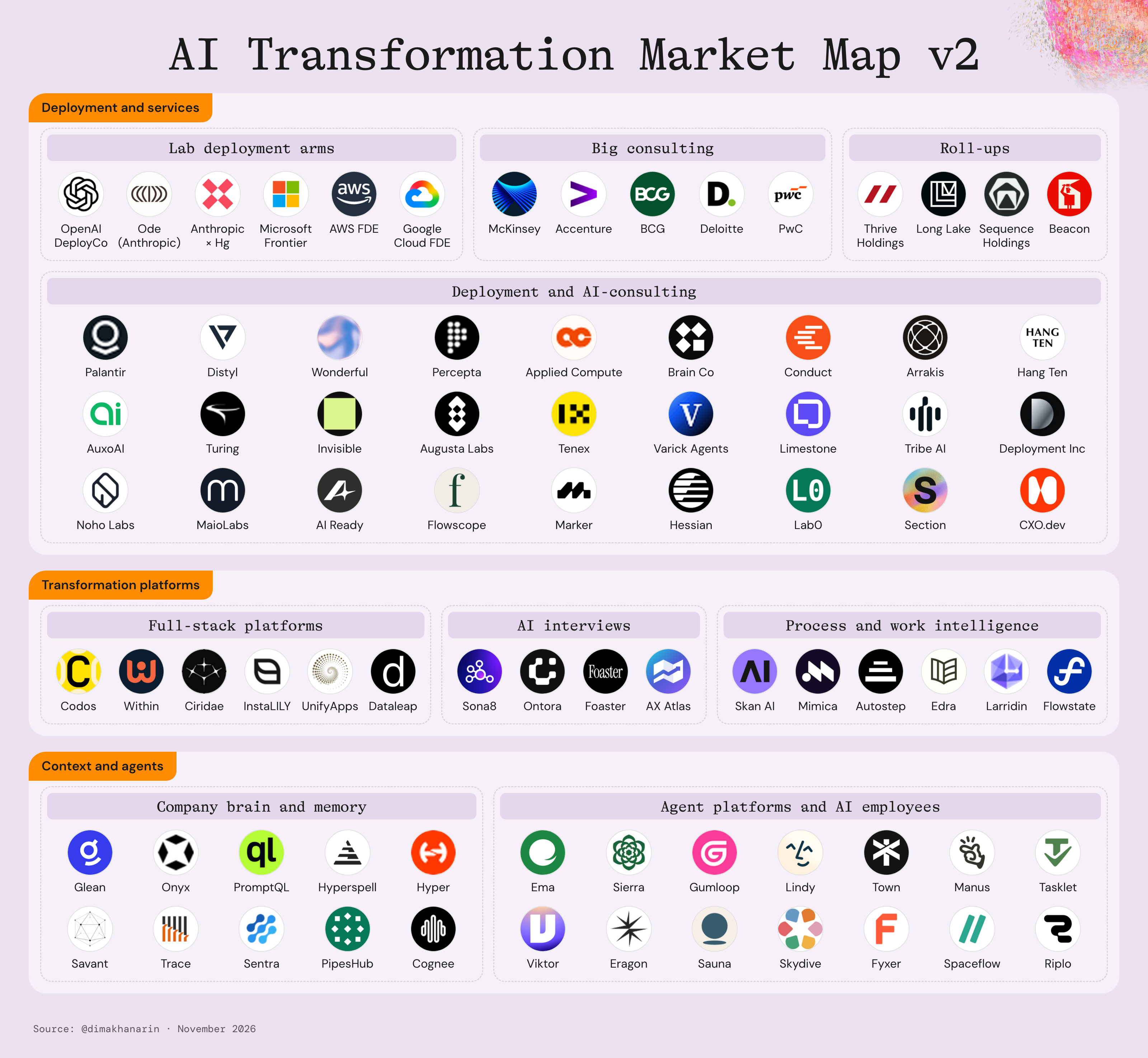
Potential customers I speak to are slowly becoming increasingly more curious about two things. Who else exists in the space? And how are you different from them?
For a long time I answered from memory. This year the market got too big for that. The AI labs started their own deployment companies, the consultancies started shipping software, and Y Combinator funded a new startup in almost every corner. So I sat down and mapped it: 82 companies in nine categories, Codos included.
This post is the comparison behind the picture. What each category sells, who it is built for, how it charges, and when it is the right choice. I compete with some of these companies, so read the part about Codos with that in mind. Everything about the others comes from public sources, checked between 8 and 16 November 2026.
Update, 16 November. This is version 2. After the first version, founders and readers sent me the names I had missed. I added 13 of them, and the map now has 82 companies.
The short version
- There are three kinds of vendor. Some sell people (deployment and services). Some sell a platform that runs the transformation. Some sell the building blocks: context and agents.
- Most of the money is aimed at the Fortune 500. The lab deployment arms alone raised more than $9B in two months.
- Pricing is the part that moves fastest. Hours are giving way to outcomes, at startups and at McKinsey alike.
- No category is the best one. The right choice depends on three things: whether you already know where AI will pay off, whether you have engineers of your own, and how big you are.
What changed in 2026
Three shifts explain most of the map.
The labs walked in. Between May 4 and July 2, OpenAI's Deployment Company raised more than $4B, Anthropic, Blackstone, Hellman & Friedman and others committed $1.5B to Ode, AWS put $1B behind forward-deployed engineering pods, and Microsoft launched Frontier with $2.5B and 6,000+ people. In October Anthropic and Hg added a consultancy for European software companies. The labs seem to have reached the same conclusion as everyone who deploys this for a living. The model is not the bottleneck. Deployment is.
Services started getting software valuations. Wonderful reached $5B twenty months after it was founded. Applied Compute reached $3.25B in eighteen. Distyl is at $1.8B. All three put engineers inside the customer and wrap them in a platform.
Consulting started turning into software. A quarter of BCG's 2025 revenue came from AI work. McKinsey runs 20,000+ AI agents next to about 40,000 people and sells an "always-on AI operating system" as a service. Accenture bought Faculty for a reported $1B. Deloitte and PwC launched agent platforms of their own. I started my career at McKinsey, and I do not think the pyramid survives this.
The comparison: nine categories
| Category | On the map | What you buy | Built for | How they usually charge | Choose it when |
|---|---|---|---|---|---|
| Lab deployment arms | 6 | Engineers funded by a model lab or a cloud, embedded in your company to build on that vendor's stack | Large enterprises and PE portfolios | Not public. Implementation is charged on top of the models | You have picked your model vendor and want the people closest to it |
| Big consulting | 5 | Strategy, change programs and large delivery teams, now with their own agent platforms | Fortune 500 and governments | Time-and-materials, fixed price, managed service. Moving toward outcomes | You need a multi-year program with global scale and board-level cover |
| Roll-ups | 4 | Nothing. They buy the company and rewire it themselves | Owners of people-heavy service businesses | No invoice. They keep the margin uplift | You would rather sell than transform |
| Deployment and AI-consulting | 27 | Forward-deployed engineers who build custom AI systems inside your operations, often on their own platform | Mostly Fortune 500, a few mid-market | Everything from story points and monthly pods to fees tied to outcomes | You know which workflow you want rebuilt and need a team to do it |
| Full-stack platforms | 6 | A platform that covers most of the path: map the work, build the agents, run them. Usually sold with a deployment team | Mid-market to enterprise, depending on the vendor | Mostly not public. Platform plus services | You want one accountable party from diagnosis to production |
| AI interviews | 4 | AI agents interview your employees and return process maps and a ranked roadmap | Companies at the very start | Per engagement, or a platform fee plus usage | You do not know yet where AI will pay off and want an answer in weeks |
| Process and work intelligence | 6 | Software that watches how work is really done (screens, tickets, logs) and shows what to automate, or measures the result | Large enterprises with a lot of repetitive desktop and ticket work | Enterprise subscription | You want evidence before you decide, or proof of ROI after |
| Company brain and memory | 10 | A context layer over your tools: search, knowledge graph or memory for people and agents | From developer teams to large enterprises | Per seat, usage, or free open source | Your people and agents keep failing for lack of context, and you have a team to build on top |
| Agent platforms and AI employees | 14 | Ready-made agents for a function, or a tool for employees to build their own | Any size, from self-serve to enterprise | Subscription tiers. Some charge per result | You have one clear, bounded job and want it running fast |
Below is each category with the companies in it. In the pricing column, "not public" means I could not find a price. It does not mean there is none.
Deployment and services
Lab deployment arms
Two years ago the labs sold tokens. Now each of them, and each large cloud, funds a company or a division whose job is to sit inside the customer and ship. You get engineers who know the models better than anyone. You also get that vendor's models and cloud by default, so decide first whether you want to be tied to one.
Ode is the one nearest to my own market: it works with mid-sized, often PE-owned companies.
| Company | What it does | Public facts | How it charges |
|---|---|---|---|
| OpenAI Deployment Company (DeployCo) | OpenAI's majority-owned forward-deployed engineering company. Runs a diagnostic, then builds OpenAI-based workflows for enterprises and PE portfolio companies | $4B+ from 19 partners led by TPG, at about $14B post-money. Started with Tomoro's ~150 engineers | Charges clients for implementation. Rates not public |
| Ode (Anthropic) | Embeds engineers in mid-sized, often PE-owned companies to build Claude-first systems | $1.5B committed by Anthropic, Blackstone and Hellman & Friedman, with Goldman Sachs and others. About 110–130 engineers. Acquired Fractional AI and Casper Studios | Custom engagements. Not public |
| Anthropic × Hg | An AI consultancy for European B2B software companies | London and Berlin, launching by year-end (FT, 23 October) | Not public |
| Microsoft Frontier | Engineers and industry specialists deployed with customers | $2.5B and 6,000+ people. Launch partners LSEG, Unilever, Land O'Lakes and Accenture | Not public |
| AWS FDE | Pods of 5–6 engineers that aim for production in about 45 days | $1B program, announced 30 June | Not public |
| Google Cloud FDE | With Accenture: a Gemini Enterprise business group of forward-deployed engineers | Accenture says about 1,000 engineers. A deal to place engineers across CVC's portfolio | Not public |
Big consulting
The large firms still have what nobody else has: thousands of people, a seat at the board, and the stamina for a five-year program. What is new is that they are building software as fast as they can. The question to ask is who actually builds, and what you own when the program ends.
| Company | What it does | Public facts | How it charges |
|---|---|---|---|
| McKinsey | AI transformation programs, forward-deployed engineers and EcliptOS, an "always-on AI operating system" it runs for clients | QuantumBlack has about 1,700 people. 20,000+ AI agents work next to about 40,000 humans. Also an investor in OpenAI's Deployment Company | Projects and retainers. Says it is moving toward outcome-based and as-a-service models |
| Accenture | Strategy, training, agent platforms and large-scale implementation | 814K people, FY26 revenue $74.2B. Bought Faculty for a reported $1B, its largest AI deal to date | Time-and-materials, fixed price and managed service |
| BCG | Strategy plus BCG X, its build arm | AI work was 25% of 2025 revenue (Bloomberg). BCG X has 3,000+ builders | Not public |
| Deloitte | Consulting plus a Global Agentic Network, launched in June 2026 | Rewrote its US career ladder around AI-enabled roles | Not public |
| PwC | PwC One, a platform where clients trigger AI agents for consulting tasks | Launched in 2026 | Exploring consumption pricing |
Roll-ups
Four names, and none of them is a vendor. Thrive Holdings buys people-heavy service businesses and rewires them with in-house engineers and embedded OpenAI staff. Long Lake and Sequence Holdings do the same, and have gone after public companies: Amex GBT and The Baldwin Group. Beacon does it with small software businesses. They matter to every owner and PE fund because they change the question. It used to be "build or buy the capability". Now there is a third option: someone buys you.
| Company | What it does | Public facts | How it charges |
|---|---|---|---|
| Thrive Holdings | Permanent-capital AI roll-up of service businesses: accounting, IT services and, once the ADT deal closes, home security | $12B valuation (August 2026). 75+ owned businesses. Agreed to take ADT private. OpenAI holds a stake | It owns the businesses and keeps the uplift |
| Long Lake | Holding company that buys services businesses and puts its own engineers and AI platform inside them | Closed a $6.3B take-private of Amex GBT in September 2026. Backed by General Catalyst | It owns the businesses and keeps the uplift |
| Sequence Holdings | Holding company that buys established services businesses and rebuilds them around AI with in-house engineers | Agreed in September 2026, with Michael Dell's family office, to take insurance broker The Baldwin Group private for about $7.7B. Not closed yet | It owns the businesses and keeps the uplift |
| Beacon | Buys small, niche software businesses and rebuilds them with AI | $225M Series C (June 2026) led by General Catalyst and HarbourVest. Co-founded by a former president of Instacart | It owns the businesses. Each keeps its own pricing |
Deployment and AI-consulting
The largest box on the map, and the widest. It runs from Palantir, with $2.31B of revenue in a single quarter, to three-person YC teams. What they share is the model Palantir made famous: engineers who sit inside your operations and build until it works. Many were founded by Palantir alumni, among them Distyl, Percepta, Conduct and Arrakis.
Most of them sell to the Fortune 500. Compare them on two things: what the invoice is for, and what stays with you when the team leaves.
| Company | What it does | Public facts | How it charges |
|---|---|---|---|
| Palantir | Data and AI platform (Foundry and AIP) sold through forward-deployed engineers and 5-day AIP Bootcamps | Q3 2026 revenue $2.31B, up 96%. US commercial $984M, up 148% | Enterprise subscription, often multi-year |
| Distyl | Engineers plus its Distillery platform build and run agentic systems in Fortune 500 operations | $1.8B valuation (Lightspeed, Khosla). Canary is its "self-improvement layer" for deployed agents | Fees tied to client outcomes, plus a platform licence |
| Wonderful | An "AI OS for the enterprise" plus local embedded teams that ship voice, chat and workflow agents | $5B, 20 months after founding. About 650 people, about 400 of them at customer sites | Platform fee, separate from the embedded staff |
| Percepta | Embedded engineers and researchers redesign operations at health systems, financial firms and governments | Owned by General Catalyst. About 60 people. Clients include Janus Henderson and the State of Maryland | Not public |
| Applied Compute | Ex-OpenAI team that trains client-owned models and keeps improving them on production traffic | $3.25B, 18 months after founding. Says it is at a $100M run rate | Not public |
| Brain Co | Builds and deploys production AI applications inside large companies and governments | $30M Series A (September 2025) co-led by Gil Capital and Affinity Partners. Co-founded by Elad Gil, Jared Kushner and Luis Videgaray | Not public |
| Conduct | Maps SAP custom code and business logic, then lets teams request changes in plain language | $60M Series A (Index, ICONIQ) with an investment from SAP. Daimler Truck, DHL, Fraport | Not public |
| Arrakis | AI agents for heavy industry: aerospace, energy, logistics, manufacturing | $38M Series A led by Blossom, six months after founding | Value-based, partly tied to customer outcomes |
| Hang Ten | Vishal Sikka's firm. Senior teams of 2–4 people replace systems-integrator projects | $85M raised (Mayfield, Xora, Aramco Ventures). Siemens Energy, Fresenius | A price tied to an outcome agreed before work starts |
| AuxoAI | Pairs of AI strategists and engineers build production systems for Global 2000 firms | $20.7M Series A (NTTVC, October 2026). Founded by ex-Genpact and PwC analytics leaders | Not public |
| Turing | Post-training data for the labs, plus a "30-Day AI Transformation Accelerator" for enterprises | $2.2B valuation | Fixed 30-day accelerator, then custom teams. Rates not public |
| Invisible | Human-plus-agent operations: data work for the labs and workflow automation for enterprises | $2B+ valuation. Its CEO ran QuantumBlack Labs at McKinsey | By usage and task volume |
| Augusta Labs | Lisbon applied-AI lab that embeds teams with enterprises, PE firms and governments | 40–50 people, €50M valuation. Partner in Sage's AI Centre of Excellence | Not public |
| Tenex | Fixed-time AI audits, Claude and OpenAI rollouts, and engineering pods | Bootstrapped, 40–75 people. Co-founded by Alex Lieberman of Morning Brew | Engineering per story point. Fixed 30/60/90-day audits |
| Varick Agents | Audits a department, then rebuilds it as agents on your existing ERP and CRM | $3.8M seed. Founded by an ex-Meta engineer | Paid audit, then value-based |
| Limestone Digital | Prague and Kyiv dev shop turned AI transformation: a free engineering diagnostic, then embedded pods | Advertises "no measured uplift, no invoice" | Says $13–18K a month per pod |
| Tribe AI | A network of 500+ vetted contract AI engineers plus in-house forward-deployed engineers | Raised only $3.25M | Per project or sprint |
| Deployment Inc | Cars24 spin-out that takes one workflow at a time to production on OpenAI models | $5M at spin-out | Paid against an agreed business metric |
| Noho Labs | Embedded engineers build custom AI systems for PE-backed portfolio companies | In stealth, based in New York. Very little is public yet | Not public |
| MaioLabs | Portuguese AI lab that builds data foundations and deploys agents inside the client's own infrastructure | About a dozen people (Tracxn) | Not public |
| AI Ready | Founder-led practice that plans and builds AI projects for growing businesses: roadmap, agents, rollout and training | Founded by Haroon Choudery, who co-founded Autoblocks AI. Says its newsletter has 50,000+ subscribers | Not public. Starts with a free discovery call |
| Flowscope | Agents shadow your teams for about two weeks, then the company redesigns the process and deploys agents | YC Spring 2026. $3.8M seed. CEO is ex-QuantumBlack | Not public |
| Marker | Forward-deployed engineers map how work happens and ship custom agents on Marker's platform | YC Summer 2026. The founders sold Drapr to Gap | Not public |
| Hessian | Forward-deployed engineers build and operate agents on Hessian's own code-first platform | YC Spring 2026 | Not public |
| Lab0 | An "AI FDE" that automates SAP, ServiceNow and Salesforce implementations | YC Spring 2026. Says it cuts six months to about ten days | Not public |
| Section | AI upskilling for enterprise workforces: an AI coach, courses and proficiency benchmarks | Founded by Scott Galloway as Section4. $30M Series A led by General Catalyst (2021). Says Havas is coaching its full workforce of 23,000 people on the platform | Not public |
| CXO.dev | Claire Vo's advisory for CEOs, CTOs and CPOs: making product and engineering teams AI-native | Run "by builders, not consultants" | Advisory fees plus a paid course |
Transformation platforms
Full-stack platforms
This is my box, so here is the honest description. The six of us do not sell the same thing. What we share is the claim that one vendor should cover the path from "where will AI pay off" to "it runs in production", with software doing as much of that as possible.
Within starts by observing work through screen share. Ciridae builds custom operating systems for PE-backed companies in the real economy. InstaLILY is deep in distribution and industrial companies. UnifyApps is an enterprise platform that sits on top of existing systems. Dataleap hands the building to business teams. We start with a diagnostic and stay to deploy.
| Company | What it does | Public facts | How it charges |
|---|---|---|---|
| Codos | A platform that runs the transformation: a 30-day diagnostic, a virtual Chief AI Officer (CAIO) and a company brain, for companies with 300–3,000 people | See "Where Codos fits" below | A 30-day diagnostic, then a monthly partnership |
| Within | A "Company Brain for AI transformation": maps how work is done into a context graph, then finds and builds agents | $90M raised. Says it mapped DoorDash's 3,800+ processes in 14 weeks | Not public |
| Ciridae | Custom "AI operating systems" that run core operations for PE-backed mid-market companies | $20M seed (Accel, a16z, General Catalyst). Founded by a former a16z partner | Not public |
| InstaLILY | Domain-trained agents for sales, service and operations, plus "Lily", an AI forward-deployed engineer | $60M Series B (July 2026). Home Depot and United Rentals invested after using it | Not public |
| UnifyApps | Connects existing systems to LLMs, then builds integrations, automations, apps and agents on top | $50M Series B (WestBridge, ICONIQ). Deutsche Telekom, Lowe's, HDFC Bank | Enterprise licence. Not public |
| Dataleap | "Vibe working": non-technical business teams build and run their own agents | YC-backed, with an office in Munich | Not public |
AI interviews
A year ago, interviewing every employee about how they work took a consulting team a quarter. Now an AI agent does it in days, and three YC companies sell it off the shelf. Our own diagnostics start with AI interviews too.
So the interview itself is no longer the product. It opens the door. What gets built afterwards decides whether the vendor stays.
| Company | What it does | Public facts | How it charges |
|---|---|---|---|
| Sona8 | A voice agent interviews every employee for 10–20 minutes and returns process maps and ranked pain points | YC Fall 2026 | Platform fee plus usage |
| Ontora | Interviews employees continuously and turns tacit knowledge into a context layer and automation roadmap | YC Spring 2026 | Not public |
| Foaster | Agents interview the whole company and deliver a human-reviewed roadmap in about two weeks | YC Spring 2026. The founders built the LLM Werewolf benchmark | A two-week assessment, then a continuous tier. Not public |
| AX Atlas | AI-led employee interviews | Very little is public yet | Not public |
Process and work intelligence
These companies do not ask people how they work. They watch: screen recordings, tickets, logs. That gives harder evidence than an interview, and it means a conversation with legal and with employees before you switch it on.
Larridin and Flowstate sit at the other end of the same job. They measure whether the AI you already bought is being used and what it returned.
| Company | What it does | Public facts | How it charges |
|---|---|---|---|
| Skan AI | Computer-vision task mining builds a context graph of work, ranks AI opportunities and runs agents on it | $63M Series C (August 2026). Says it serves 7 of the top 10 US banks | Enterprise subscription |
| Mimica | Records desktop work into process maps, then turns them into instructions for AI agents | $26M Series B led by Paladin | Not public |
| Autostep | A desktop app that records computer use, prices repetitive work in dollars and spawns automation agents | YC Spring 2026 | Discover is free. Automate is $1,900 a month |
| Edra | Mines tickets, logs and messages into "Living Playbooks" that agents execute | $30M Series A from Sequoia. ASOS, HubSpot, easyJet | Not public |
| Larridin | Measures AI adoption, productivity gains and AI spend: an audit of AI ROI | $30M Series A led by Pelion (November 2026) | Not public |
| Flowstate | Attributes AI spend to people, projects and outcomes, so a company can show what its AI returned | London, pre-seed. Co-founded by Oliver Beach and Will Hackett | Not public |
Context and agents
Company brain and memory
Everyone is building a company brain, us included. The idea is simple: agents and people fail for lack of context, so put all of it in one place and keep it current. The hard parts are less visible. Permissions are one. Hyperspell's CEO wrote an essay called "The company brain has a permissions problem", and he is right.
A brain is infrastructure, not an outcome. Buy one when you have a team that will build on top of it.
| Company | What it does | Public facts | How it charges |
|---|---|---|---|
| Glean | Permission-aware search, assistant and agents over 100+ apps | $7.2B valuation. $300M ARR (May 2026) | Per seat, plus usage for agents |
| Onyx | Open-source enterprise search, chat and agents. Can be self-hosted | 30K+ GitHub stars, 18 people. Acquired by Zoom in September 2026 | Free open source. Cloud is about $20 per user a month |
| PromptQL | Hasura's agentic workspace over enterprise data | Built by the Hasura team | Not public |
| Hyperspell | An API and SDK: a permission-aware context graph over Slack, Gmail, Notion and Drive that any agent can read and write | YC Fall 2025 | Not public |
| Hyper | A self-serve "self-driving company brain" that maintains its own knowledge graph | YC Spring 2026. Both founders were forward-deployed engineers at Snorkel AI | Self-serve subscription. Not public |
| Savant | Captures knowledge that was never written down and serves it to agents as skills | YC Spring 2026 | Not public |
| Trace | A knowledge graph plus a router that splits workflow steps between agents and humans | YC Summer 2025, London. $3M seed | Per seat |
| Sentra | A company brain that joins meetings, Slack and Jira. Runs on-prem or air-gapped | $5M seed (a16z speedrun, Together Fund) | Not public |
| PipesHub | An open-source context layer and enterprise search for agents | Apache 2.0. Self-hosted or cloud | Open source |
| Cognee | A memory layer for agents: remember, recall, improve, forget | Berlin. $7.5M seed led by Pebblebed | Not public |
Agent platforms and AI employees
The most crowded shelf, and the easiest one to buy from. Some sell a finished agent for one function, like Sierra for customer service or Spaceflow for procurement. Others give every employee an assistant or a tool to build their own.
They work well for a bounded job. Changing how a whole company runs takes more than one of them.
| Company | What it does | Public facts | How it charges |
|---|---|---|---|
| Ema | A "universal AI employee" for HR, IT and finance workflows | $77M Series B (September 2026) | Enterprise subscription |
| Sierra | Customer-service agents for large consumer brands | $15.8B valuation. $950M Series E (May 2026) | On outcomes, such as resolved conversations |
| Gumloop | No-code: any employee builds and shares agents, with IT controls on data and permissions | $50M Series B from Benchmark, about 25 people. Shopify, Ramp, Instacart | Self-serve tiers plus enterprise plans |
| Lindy | AI employees for email, calendar and CRM | Founded by Flo Crivello | Not public |
| Town | Every employee gets a personal AI agent across email, calendar, chat and apps. It asks for approval before important sends | $108M Series B at a $1B valuation (Forerunner, Menlo), after a $55M Series A led by a16z | Not public |
| Manus | A general-purpose agent that completes multi-step tasks (research, analysis, sites, slides) on its own cloud computer | Raised more than $500M in October 2026, co-led by Boyu Capital and IDG Capital | Credits. Team and enterprise plans |
| Tasklet | Cloud agents that automate recurring business workflows across connected apps from plain-language instructions | YC Spring 2026. $20M at a $175M valuation (April 2026), co-led by Union Square Ventures and Lightspeed. The founders come from Firebase's founding team | Free tier, then credits billed per organization |
| Viktor | An AI coworker that lives in Slack | Says it connects to 3,000+ tools | Not public |
| Eragon | An "AI operating system" that post-trains open models on customer data in the customer's cloud | $12M at a $100M valuation (March 2026) | Not public |
| Sauna | An AI assistant for professional work | Built by the Wordware team | Not public |
| Skydive | AI coworkers for teams: each has its own cloud computer and takes tasks in Slack, email or iMessage | Launched in August 2026 by Anything, the app builder, after a closed beta with 20+ companies | Not public |
| Fyxer | An AI assistant inside Gmail and Outlook: sorts the inbox, drafts replies in your voice, writes meeting notes | $30M Series B led by Madrona (September 2025). Says it reached 180,000+ users in seven months | Per seat, with a free tier |
| Spaceflow | AI employees that run procurement workflows end to end, on-prem or sovereign | YC Summer 2026. Says $400M of supplier spend runs through it | Not public |
| Riplo | An agentic operating system for consulting firms | London | Not public |
The real difference is how they charge
If I had to compare these 82 companies on one axis, it would not be technology. It would be what the invoice is for.
- Time. Time-and-materials and retainers, still the default at the large firms.
- Seats and usage. Glean charges per seat plus usage for agents. Trace charges per seat. Onyx is free to self-host and about $20 per user a month in the cloud.
- Output. Tenex bills engineering per story point. Invisible charges by task volume.
- Outcome. Sierra prices on outcomes such as resolved conversations. Distyl ties its fees to client outcomes. Hang Ten agrees the outcome before work starts. Deployment Inc is paid against an agreed business metric. Limestone advertises "no measured uplift, no invoice".
- Ownership. Thrive skips the invoice and buys the company.
The direction is the same everywhere. McKinsey says it is moving away from classic fee-for-service toward outcome-based and as-a-service models. PwC is exploring consumption pricing.
So ask every vendor three things. What exactly do I pay for? Who measures it? And what happens if it does not show up?
How to choose
| Your situation | Start with | Why |
|---|---|---|
| You do not know where AI will pay off | AI interviews or work intelligence | A ranked list of opportunities in weeks, before you commit to a build |
| You know the workflow and need it rebuilt | A deployment firm | Engineers on site, one workflow at a time. Compare them on pricing and on what you keep |
| You are a Fortune 500 with a model vendor chosen | That vendor's deployment arm | Nobody knows the models better |
| You need a multi-year program across countries | Big consulting | Scale and governance, and they now build too |
| Your own engineers want to build it | A company brain plus an agent platform | You keep control, and you carry the work |
| You have one bounded job, like support or procurement | An agent platform | Fastest to live, and often priced per result |
| You have 300–3,000 people, no AI team, and an owner who wants it in the P&L this year | A full-stack platform | One party accountable from diagnosis to production |
| You run a PE fund | Decide per portfolio company: build, partner, or sell to a roll-up | The answer is rarely the same across the portfolio |
Where Codos fits
The clearest way to explain what we do is one client.
A midsize payments company set itself a single goal for 2026: double revenue per employee. Six months in, the program had produced several $M in realized savings. I wrote up how it worked in the AI transformation playbook.
What we sell is those results that come from our platform. It starts with a 30-day diagnostic built on AI interviews. Then our virtual CAIO builds what the diagnostic found. Underneath sits a company brain that runs on the client's own infrastructure. We agree the baseline before we start, and the client's finance team reviews the savings.
It is built for companies with 300 to 3,000 people, often PE-backed, with a CEO who needs AI to show up in the P&L this year and no internal team to make that happen.
It is not built for everyone. If you are a Fortune 500 with a model vendor already chosen, the lab arms and the larger deployment firms are built for you. If your engineers want to build it themselves, buy a brain and an agent platform. If you have one bounded job, buy the agent.
Two things we measure in public. Retrieval quality of the brain, in our EnterpriseRAG-Bench write-ups. And self-improvement: we ran 83 experiments on our own org brain and shipped the 15 that measurably improved it. Several companies on this map say their systems improve themselves in production. Few publish numbers. I think that is the next thing buyers should ask all of us for.
I'm Dima Khanarin, CEO of Codos. We work hands-on with a small number of mid-market and PE-backed companies on exactly this: finding where AI pays off, building it, and running the company brain underneath. If you are comparing options and want a second opinion on your shortlist, get in touch. And if your company is missing from the map or I got it wrong, tell me. I will fix it in the next version.
FAQ
A company that helps another company change how work gets done with AI, and takes responsibility for more than a tool: finding where AI pays off, building it, and getting people to use it. On this map that covers services firms, platforms, and the context and agent layers they build on.
This map has 82, and it is not exhaustive. It covers companies that sell the transformation itself or the layers it is built on. It leaves out the labs' core model products and most single-function AI apps. Nineteen of the 82 came through Y Combinator, nine of them from the Spring 2026 batch alone, so the count will be out of date quickly.
An engineer who works inside the customer's company, on the customer's data and processes, until the system is in production. Palantir made the model famous. In 2026 it became the default way to sell AI deployment: OpenAI, Anthropic's partners, AWS, Microsoft and Google all fund forward-deployed teams.
Few vendors publish prices. The public ones run from free open source (Onyx, with a cloud version at about $20 per user a month) and $1,900 a month for Autostep's Automate tier to embedded engineering pods, which Limestone lists at $13–18K a month. Engagements with the lab arms and the large consultancies are not disclosed. What is changing is the unit of price: story points at Tenex, outcomes such as resolved conversations at Sierra, an agreed business metric at Deployment Inc and Hang Ten.
Ode works with mid-sized, often PE-owned companies. OpenAI's Deployment Company counts PE portfolio companies among its clients. Anthropic and Hg are building a consultancy for European B2B software companies. Google Cloud has a deal to place engineers across CVC's portfolio. Ciridae builds for PE-backed companies in the real economy. Tenex and Limestone sell to the mid-market, and so do we at Codos.
If you have strong engineers and a CEO who will drive it personally, yes: buy a company brain and an agent platform and build on top. If either is missing, an outside team will be faster. The playbook covers what the CEO has to do in both cases.
From public sources: company sites, funding announcements and press, checked between 8 and 16 November 2026. Where a number comes only from the company itself, the text says "says".